
Last updated: August 31, 2026
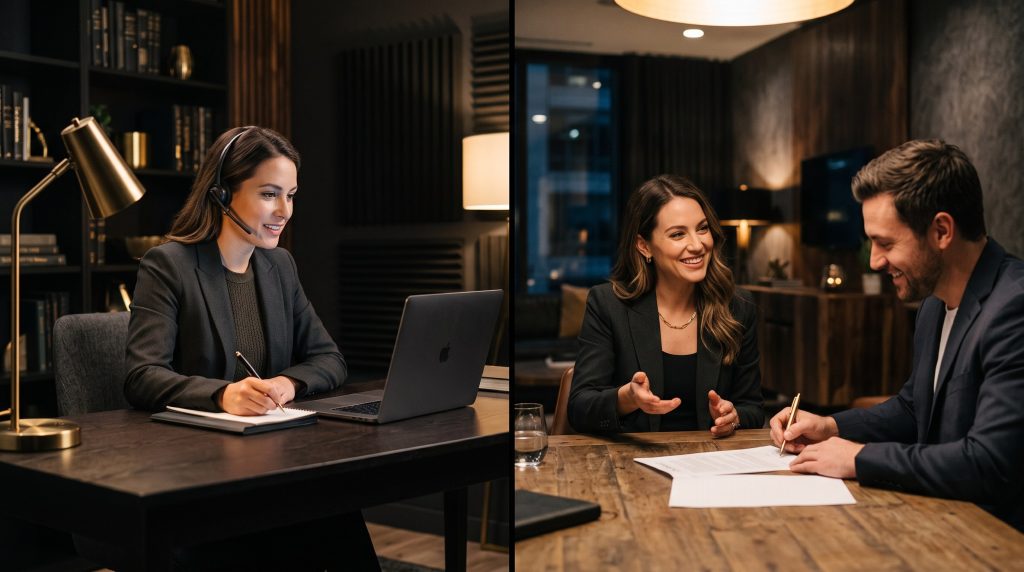
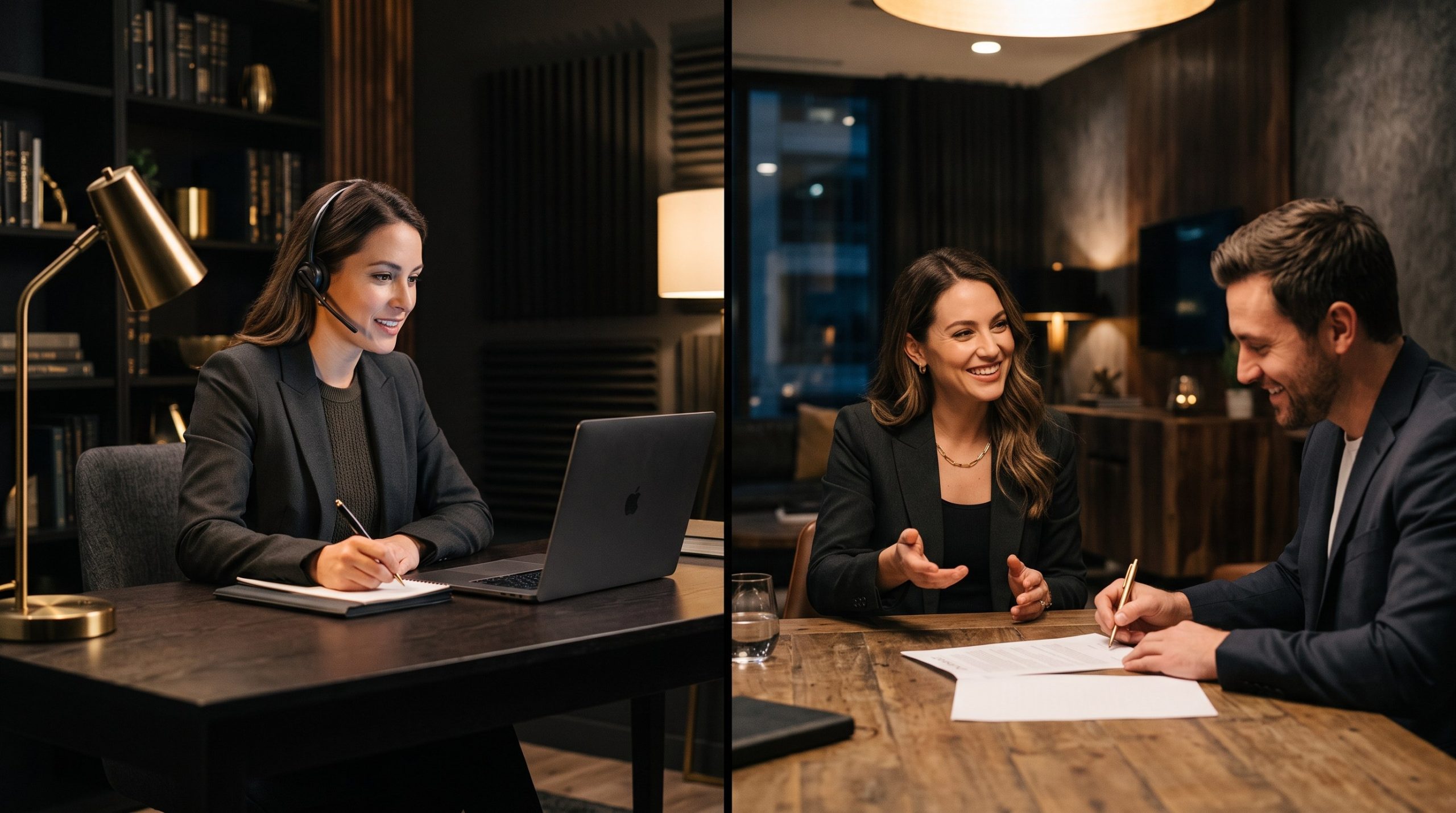
Closing on a video call vs in person is not two different skills. It is one decision, reached through a smaller window. Most sellers think video is the harder version. It isn’t.
Tim came to me closing around $4,000 a month, all of it on video calls. His calls felt fine. They also stalled, and he blamed the screen. The screen was not the problem. He was reaching the offer before the buyer felt the gap, and that fails the same way in a boardroom as it does on Zoom. We slowed down the front half of his calls. Eight weeks later he was at $40,000 a month, closing the same buyers, on the same video calls he thought were holding him back.
What is the difference between closing on a video call and in person? Closing on a video call and closing in person are the same decision reached through different amounts of information. In person you read the full body, the room, and the pauses. On video you get a face in a box and a small delay. In both, the buyer decides the same way: they feel the gap between where they are and where they expected to be, and they believe you can close it. The medium changes what you can see. It does not change how the decision gets made.
Key Takeaways
- The medium does not close the deal. Discovery does. Video and in person run on the same mechanism.
- In person ranks as the most effective sales channel; video ranks lower, but the gap is a signal-reading problem, not a closing problem.
- On video you lose the full body and the room. You compensate with tighter questions and longer pauses, not more talking.
- Silence works on both. In person it reads as thought. On video you name it so it doesn’t read as a frozen screen.
- The same framework closes both. Fix the call, not the close, and the medium stops mattering.
Does Closing on a Video Call vs In Person Change Your Close Rate?
The medium moves your close rate less than you think, and never on its own. In-person selling still ranks as the most effective channel and video sits lower, but that ranking measures averages, not ceilings. In HubSpot’s sales statistics roundup, meeting in person ranks as the most effective sales channel while video calls rank fifth. The same research found 56% of sales professionals say remote selling has made it easier to sell, and hybrid teams are 28% more likely to outperform fully in-person or fully remote ones.
Read those numbers together and the story is not “video is worse.” It is that most sellers never adapted. They took an in-person call, pointed a webcam at it, and lost the parts of their read that were doing quiet work. The close rate dropped, and they blamed the medium instead of the transfer.
Close rate is a lagging indicator. It follows the quality of the call, not the camera. A seller who runs clean discovery on video will beat a seller winging it across a desk, every time. The screen did not decide that. The call did.
What Actually Changes Between Video and In Person
What changes is the information you have to work with, not the decision you are guiding toward. In person you get the whole signal: posture, feet, the shift in the chair, the pause that means they are thinking. On video you get a cropped face, a half-second delay, and a buyer who is one tab away from their inbox. That is a narrower channel. It is not a different job.
Here is the honest breakdown of what moves between the two, and the one thing that doesn’t.
| Element | In person | On a video call |
|---|---|---|
| Body language | Full body, feet, posture, the room | Face and shoulders only, on a delay |
| Silence | Reads as thinking, easy to hold | Can read as a frozen screen, so you name it |
| Attention | Hard for the buyer to escape | One click from email, so you earn it |
| Frame control | You own the room by being in it | You own it with structure and the agenda |
| Showing the offer | Paper, whiteboard, physical presence | Screen share, slides, a shared document |
| The decision | Gap surfaced, buyer decides | Gap surfaced, buyer decides |
Look at the bottom row. The decision mechanism does not move. Buyers decide on feeling and justify with logic, on video and across a table alike. The moment they feel the gap between where they are and where they expected to be, and believe you are the bridge, they decide. Everything above that row is about how clearly you can see it happening, not whether it happens. The buying signals you learn to read on a sales call are the same signals; on video you are reading a smaller set of them.
How to Close on a Video Call
Closing on a video call comes down to protecting the read you lose to the screen. You can’t see the feet or feel the room, so you replace that lost signal with tighter questions and more disciplined silence. The buyer still has to feel the gap. You just have less to work with while you surface it, so you waste nothing.
Ask fewer, sharper questions and let them run long. On video, a buyer will fill dead air with an honest answer if you let them, and that answer is where the gap lives. This is where most people flinch. The screen goes quiet, they panic, and they rescue the silence with another point. That takes the conviction out of the buyer’s mouth and puts it in yours, which the buyer does not own. Hold the pause. Then, because a long silence on video can read as a frozen connection, name it: “Take a second with that. What’s coming up for you?”
Own the frame with structure, since you can’t own it with presence. Set the agenda in the first two minutes. Tell them this is a diagnostic conversation, not a pitch, and that you will both know by the end whether it is a fit. That frame does on video what standing in the room does in person. It tells the buyer who is guiding this. When you reach the decision, drop the next step into the chat while you say it: a calendar link, a start date, a specific action with a day attached. A named next step on the screen is harder to walk away from than a vague “I’ll follow up.”
The camera did not make the sale harder. It removed the signals you were leaning on without knowing it. Get them back through better questions and cleaner structure, and video closes as well as any room.
How to Close in Person
Closing in person gives you more signal, and more ways to waste it. You have the full body, the room, and silence that reads as thought instead of a dropped call. The risk is that the richer read tempts you to rely on rapport and presence, and skip the work that actually closes. A warm room is not a surfaced gap.
Use the extra bandwidth to read, not to perform. Watch the posture shift when a certain problem comes up. Notice the moment the guarded energy turns engaged and they start asking how it works and when they can start. That is the internal decision landing, and in person it is easier to catch than on any screen. When you see it, stop selling. Confirm the next step. Every extra minute of persuasion past the yes invites doubt back into a decision that was already made.
The trap in person is comfort. Rick was warm, likeable, and closing at 6%. Rapport was never his problem. The gap was. He was having good conversations across a table that ended without the buyer ever feeling the cost of staying put. He went from 6% to 32% in about a month, and closed $351,000 in that month, without becoming a different person. He changed the call, not the charm. In person or on video, connection without conviction does not close.
The Framework Is the Same on Both
The same framework closes a video call and an in-person meeting, because the framework was never about the medium. Tactics are situational: this line for this objection, that transition for that moment. They work once and fail twice, and they fall apart the instant the medium changes. A system works on every call, in any room or any browser, because it runs on how the buyer decides, not on where they are sitting.
That system is the CONSULT Method built for coaches and consultants: approach with curiosity, own the frame, surface what they need, help them see the future, use their own words back to them, listen for objections, and end on a thank you. None of those seven steps care whether you are on Zoom or across a desk. Curiosity is curiosity. Owning the frame is owning the frame. The step-by-step structure of a sales call holds on both mediums, start to finish.
This is why the close is downstream. Sellers hunt for a better closing line when the medium changes, as if video needs its own magic phrase. It doesn’t. In Gong’s analysis of B2B sales calls, winning and losing closing calls look nearly identical. The discovery calls are where they diverge. The close didn’t need to change for Rick or Tim. The call that preceded it did. If the gap is undeniable, the close is a formality, and it is the same formality whether the buyer nods at you across a table or through a webcam. Get the discovery right and the medium becomes a detail.
If you sell on video and can’t tell where your calls are leaking, that blindness is the real remote problem, not the screen. Reviewing your own recordings shows you the exact moment the buyer went cold. The NL OS reviews your video calls in my frameworks and flags where the gap went unsurfaced, so you fix the call instead of blaming the camera. It closes the feedback loop problem in remote sales that keeps video closers guessing.
Frequently Asked Questions
Is it harder to close a sale on a video call than in person?
It is not inherently harder. In-person selling ranks as the most effective channel on average, but that reflects sellers who never adapted their read to video, not a ceiling on video itself. On a video call you lose the full body language and the room, so you compensate with tighter questions and longer silences. The decision mechanism is identical. A clean video call beats a sloppy in-person one every time.
What closing techniques work on a video call?
The same ones that work in person, because closing technique is downstream of discovery. Surface the gap between where the buyer is and where they expected to be, let them feel it, and recognize the moment they decide. On video, add three habits: hold silence and name it so it doesn’t read as a frozen screen, own the frame with a clear agenda, and drop the specific next step into the chat as you say it.
How do you read body language on a video call?
You read a narrower set of signals and lean harder on what you can see. Watch the face and shoulders for the shift from guarded to engaged. Listen for the change in energy and the move to practical questions, how it works and when we can start, which signals the internal decision. Because you lose the feet, posture, and room, you replace that lost read with sharper questions and disciplined pauses that pull the honest answer out.
Do buyers prefer video calls or in-person meetings?
It depends on the buyer and the offer, and it matters less than sellers assume. Many buyers now prefer the convenience of video, and 56% of sales professionals say remote selling has made it easier to sell. What moves the decision is not the channel preference. It is whether the seller surfaced the gap. A buyer who feels the cost of staying put will buy on whichever medium you are on.
Should I turn my camera on for a sales call?
Yes, on any call the buyer expects to be on video. Your read depends on seeing their face, and theirs depends on seeing yours. A camera-off call strips both of you back to phone-level signal while keeping the awkwardness of a scheduled video meeting. If you are going to sell on video, be on video, look at the camera when it matters, and use the face-to-face read you still have.
The Summary
Closing on a video call versus in person is not two different skills. It is one decision, seen through two different windows. In person you get the full read and the risk of coasting on rapport. On video you get a narrower read and have to earn attention and protect silence. The buyer decides the same way in both, the moment the gap becomes undeniable.
Stop treating the medium as the problem. Fix the call, and the camera stops mattering. The same discovery, the same framework, the same clean close works on Zoom and across a table.
If you sell on video and your calls feel fine but don’t close, the Dissonance Diagnostic Call will show you the exact point your calls lose the buyer and what to change first. Not a pitch. A diagnosis.